
Glock vs Everything Pt. 2: Glock 45 (9mm) vs Smith & Wesson M&P 2.0 Metal
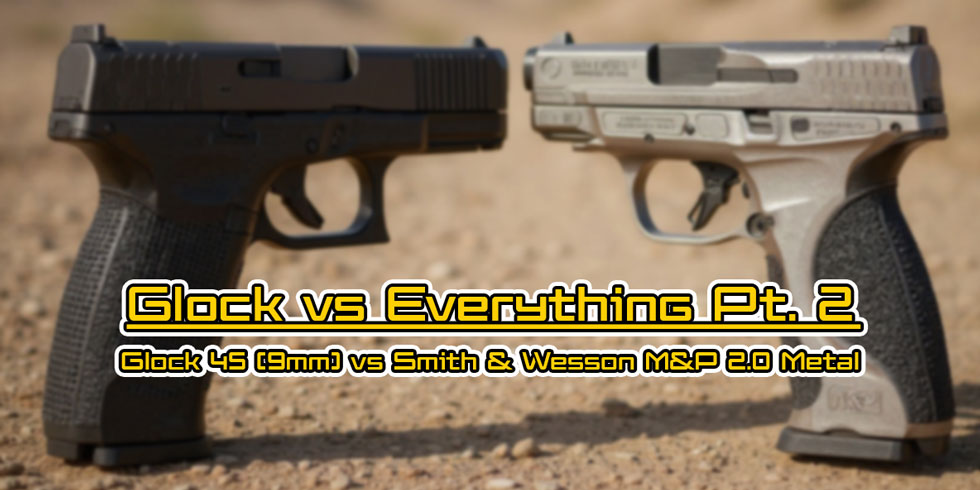
The debate between Glock and Smith & Wesson is as timeless a debate as Coke versus Pepsi, with loyal fans on both sides championing their preferred platform. In this installment of Glock vs Everything, we are putting the Glock 45 (9mm) head to head with the full size Smith & Wesson M&P 2.0 Metal. Both guns have earned praise and professional adoption for their performance, reliability, and ergonomics, and this comparison aims to break down the nuances that set them apart from design and feel to real world shooting performance.
Both of these pistols reflect how their manufacturers respond to user demand. The Glock 45 emerged as a civilian evolution of the Glock 19X, blending a Glock 17 length grip with a Glock 19 length barrel to give shooters better leverage and recoil control while keeping the slide compact. Meanwhile, the Smith & Wesson M&P 2.0 Metal was developed during the recent rise in all metal striker fired pistols and has been widely praised as the pinnacle of S&W’s lineup. Both guns have earned professional recognition, becoming go to choices for law enforcement, security teams, and military units.
Glock 45 vs. Smith & Wesson M&P 2.0 Metal

| Model | Barrel Length | Overall Length | Trigger Pull | Grip Angle | Capacity | Optics Ready |
|---|---|---|---|---|---|---|
| Glock 45 9mm | 4.02” | 7.4 | 5.5 Lbs | 22” | 17+1 | No |
| S&W Metal 2.0 | 4.25 | 7.4 | 4.75 Lbs | 18” | 17+1 | Yes |
Grip Geometry, Texture, and Trigger Feel
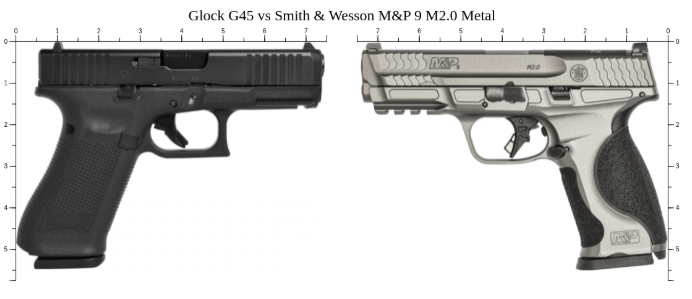
One of the first things you notice when handling these pistols is how different the grip geometry feels in your hand. The Glock uses a steeper 22 degree grip angle and a slightly narrower frame, while the Smith & Wesson sits closer to an 18 degree angle with a wider profile, giving it a feel more reminiscent of the classic 1911. The texture is another obvious divider: the aggressive signature stippling on the M&P 2.0 allows for a much more secure grip than the Glock, especially under recoil or in wet conditions. However, that same texture can be rough on the hands and skin until it goes through a bit of a break in period.
Uses a bladed stock trigger with a trigger wall that tends to break sooner, producing quicker splits.
Uses a flat face trigger shoe, with take up that feels smoother and more controlled to many shooters.
Ergonomics and Aftermarket Support
In this regard, I would give the narrow head nod to the M&P. Glock’s stippling has improved across various generations, but it still lags behind many competitors in raw purchase. Where Glock evens the score is its massive, affordable aftermarket ecosystem; you can tailor a Glock into whatever you want, and that ubiquity may explain why the company has not leaned into ultra aggressive factory texturing. Smith & Wesson’s aftermarket support is growing, but it is not yet at Glock’s scale, so your choice might come down to whether you want the out of the box ergonomics and weight of the M&P or the endless customization options of the Glock.
Weight and Recoil Management
Weight is also a noticeable factor at the range: the M&P 2.0 Metal clocks in around 30 ounces versus roughly 24 ounces for the Glock 45. That extra heft on the Smith & Wesson is immediately noticeable behind the trigger; it helps tame recoil and improves recoil management and smooths out follow up shots, but it also makes the gun feel more substantial during longer strings of fire.
Real World Shooting Drills
We had one of our instructors put both pistols through a few comparison drills, and the results echoed what you tend to feel in real world shooting: Glock for speed, M&P for accuracy.
Drill 1: 3 Rounds, Reload, 3 Rounds
Drill 2: Double Feed Malfunction Clearing
Drill 3: 1 Reload 1 Reload 1
Final Verdict
Overall, the numbers were fairly close but consistent; the Glock proved to be the faster platform, while the Smith & Wesson edged out in stability and accuracy. It was such a close call that we may have to switch up the drills and run a part 2 of these trials to see if one platform can definitively pull ahead.
If you want speed, smooth ergonomics, and the largest aftermarket for custom work, the Glock is hard to beat.
If you want out of the box purchase, a heftier metal platform that soaks up recoil, and a more planted feel with stricter shot placement, the M&P 2.0 Metal earns that narrow nod.
Explore XTech Tactical Smith & Wesson Magazines

Devin Perkins
Devin Perkins is a pistol instructor with eight years of teaching experience, a contributing writer for Recoil magazine for five years, and the Content Director at No Other Choice Firearms. He tests gear on the range and in real-world carry rigs to give practical, experience-driven advice to shooters looking for reliable upgrades and better performance.