
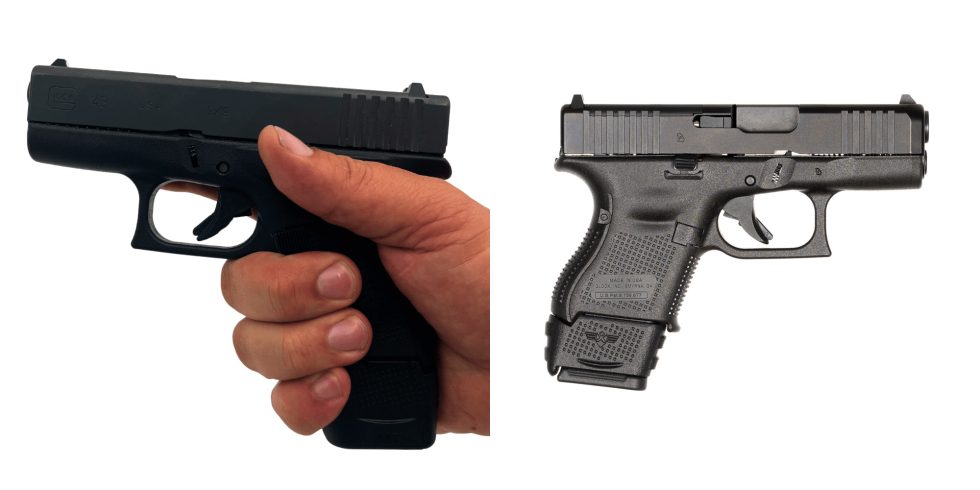
The Glock series of handguns have become renowned for their accuracy, reliability, simplicity, and market dominance. Glock has produced semi-auto handguns for nearly every single handgun purpose. They dominate most markets, including the concealed carry market. Two of their most popular concealed carry options are the Glock 26 and Glock 43. If you’ve always wanted to know the difference between the two, you’ve come to the right place as we intend to break down every difference in today’s Glock 26 vs. Glock 43 breakdown.
Glock 26 Vs. Glock 43 – Why?
Why compare these two guns specifically? Tons of Glocks are used for concealed carry, so why do we get a Glock 26 vs. 43 article instead of a Glock 21 vs. 43 article? I’m comparing the two because of how much these two guns have in common. The Glock 26 and Glock 43 have tons in common, which makes them natural candidates for an in-depth comparison.
As a consumer and potential purchaser, you might start to wonder what the actual difference is between two guns that are both small enough to easily conceal and are both chambered in 9mm. Both feature largely the same overall layout. They are remarkably similar, and in my experience, when two guns share core similarities, what makes them different is what really matters.
Introducing the Candidates
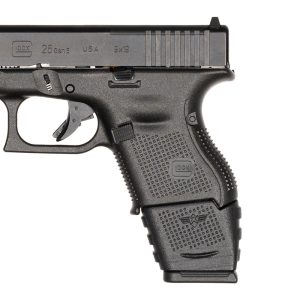
Since the Glock 26 is the older gun, we’ll cover it first. As the name implies, the Glock 26 was Glock’s 26th patent. Glock has five generations of firearms, and the Glock 26 premiered with the second generation of Glock pistols. The weapon has maintained constant production since and is produced alongside the 5th generation of Glock pistols. The Glock 26 is considered a subcompact pistol and the baby of the Glock 17 and Glock 19 pistols.
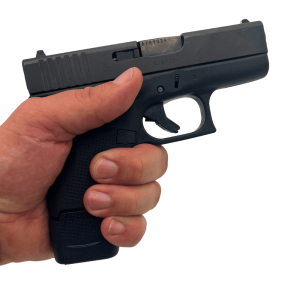
The Glock 43 wasn’t Glock’s first single-stack pistol, but it was Glock’s first single-stack 9mm pistol. It premiered at a time when the single-stack 9mm was the hot ticket, and with Glock’s brand recognition, it became a big hit. Glock does not utilize the generation differences for the Glock 43. Instead, it falls into a bit of a hybrid of generations. Glock classifies the Glock 43 as a slimline pistol.
Size Matters, Right?
The most noticeable difference from a 10,000-foot view is size. Sure, both are small guns, but they are a fair bit different when we whip out a measuring tape. Size matters for several purposes, and for concealed carriers, the smaller the gun, the easier it is to hide.
| Specification | Glock 26 | Glock 43 |
|---|---|---|
| Barrel Length | 3.43 inches | 3.39 inches |
| Overall Length | 6.42 inches | 6.26 inches |
| Height | 4.17 inches | 4.25 inches |
| Width | 1.30 inches | 1.02 inches |
| Weight | 21.69 ounces | 16.19 ounces |
| Capacity | 10 Rounds | 6 Rounds |
The Glock 26 vs Glock 43 spec differences are clear, but it doesn’t seem major, does it? If you look at those specification tables and they don’t speak to you, don’t worry. The differences can seem minor, especially if you’ve never carried a firearm. The Glock 43 is much thinner, and while 0.28 of an inch doesn’t seem like much, it makes a big difference both in your hand and in your waistband.
The extra width can make the gun less comfortable to carry, a problem magnified for smaller individuals. The thinner grip of the G43 can feel super comfortable for shooters with smaller hands. The additional weight of the Glock 26 can help and hurt: it’s more weight to carry, but it creates less felt recoil.
Height and length will affect concealment. Smaller is usually easier to conceal. However, for appendix carry, some additional slide length can help conceal the weapon by pushing the grip rearward to reduce printing.
Capacity Matters Too
A major difference in those specs is capacity. If you’re all about capacity, then the Glock 26 vs. 43 argument is over for you. The Glock 26 wins with its 10-round stock capacity (plus one in the chamber brings you to 11 rounds). The Glock 43 maxes out at 6+1. The Glock 26 uses double-stack magazines, while the Glock 43 sticks to a single-stack design.
The Glock 26 can also use Glock 19, Glock 17, and even Glock 33-round magazines without a problem. XTech Tactical Mag Adapts fill in the extra space when using a 15-round magazine or 17-round magazine, giving the shooter more grip space and control.
Mag Adapts also work with extended magazines such as the MAG19 EXT for 20-round capacity or MAG17 EXT for 22-round capacity.
The Glock 43 also has options for increased capacity. XTech produces a plus-three baseplate that brings your capacity to 9 rounds and extends the grip slightly for greater control. XTech also sells complete magazines with the +3 extensions pre-installed.
Still, at the end of the day, the Glock 26 will always hold more ammunition.
Accuracy
Accuracy can be tough to gauge with compact handguns. At the end of the day, we have to distinguish between practical accuracy and mechanical accuracy. Practical accuracy comes down to user skill. Glock firearms are more than accurate enough for the average user, and most shooters will find themselves shooting with similar accuracy using either pistol.
The trigger pull, grip length, and sight radius are all very close, if not identical in some cases. However, we see a key difference in accessories, specifically with the Glock Gen 5 MOS. The Gen 5 introduced an optics-ready Glock 26, and red dot sights make handguns significantly easier to shoot accurately.
Red dots eliminate sight radius and alignment issues while providing a precise point of aim that covers less of the target.
The Glock 26 Gen 5 pistols also feature Glock’s match-grade Marksman Barrel, providing exceptional mechanical accuracy and shot-to-shot consistency.
Ergonomics
The two guns share nearly identical controls. The Glock 26 Gen 2, Gen 3, and Gen 4 operate similarly to the Glock 43. However, the Gen 5 features an ambidextrous slide stop. Both guns feature a similar grip angle, but the Glock 26 is noticeably thicker overall.
Shooters with smaller hands will likely prefer the thinner grip profile of the Glock 43, whereas most others will feel comfortable with the Glock 26. One hidden benefit of the Glock 26 is its added width: it disperses recoil energy over a wider surface area, resulting in a smoother recoil impulse.
Gen 3 and Gen 4 26 models feature finger grooves that divide user opinion. The Gen 5 removes these grooves in favor of a smooth grip featuring rough texture stippling to keep the pistol firmly anchored in hand.
The Glock 26 also features interchangeable backstraps to customize grip size, whereas the Glock 43 offers a fixed grip profile. While ergonomics are subjective, the Glock 26 provides noticeably more ergonomic modularity than the G43.
A Clear Winner?
Is there a clear winner? Let’s review the facts:
Both guns have distinct strengths, and ultimately, there isn’t a single “best” option—only the best option for your individual needs. Weigh the pros and cons, consider your primary carry requirements, and choose the platform that feels best for you.